Vivre Activewear:
$10k to $2M, closed the stores, still very much alive.
Sylvia started with $10,000 and a gap in the market. We scaled it to over $2 million in annual revenue, ran stores across Singapore for a decade, and closed every single one on our own terms. This is that story.
$10,000, a gap in the market, and 10 orders a day.
In 2014, Sylvia looked at the activewear market and saw a simple problem. If you wanted quality yoga and athleisure wear in Singapore, your options were the expensive international labels like Lululemon, or cheap fast-fashion stuff that did not hold up. Nothing in the middle.
She allocated $10,000 from her savings, gave herself one year to figure out if it could work, and launched Vivre Activewear as an online-only store.
Early traction came faster than expected. When local influencers like Zoe Raymond and Tammy Tay started wearing the brand, web traffic spiked and daily sales crossed $1,000 within months of launch. Sylvia pooled over $20,000 with our families to fund the first few production batches.
I joined before the open house. By then I could already see the business had legs. What pushed me over was watching Sylvia spend two hours every single day just packing ten orders. That is not a founder problem. That is an operations problem. And operations problems are fixable.
One open house. One decision. No looking back.
We planned a two-day open house shopping weekend at Sylvia's mother's place. Saturday and Sunday. Simple enough.
Saturday hit over $1,000 in revenue. Almost every single person who walked in bought something.
I told Sylvia to cancel Sunday. We were opening a retail store instead.
Within two weeks, we had our first outlet at Far East Plaza. Rental was $4,000 a month. We ran the counter ourselves at the start, then brought in part-timers, then full-timers as volume grew. That first store taught us a lot about how customers respond to being able to touch and try the product in person.
From one store to the sweet spot formula.
Over the next few years we expanded across Singapore. The rotation looked like this:
- Far East Plaza + Bugis Junction + Wisma Atria
- Bugis Junction + Wisma Atria + Vivo City
- Wisma Atria + Vivo City + Tampines One
- Wisma Atria + Vivo City
- Vivo City (final store)
Three stores was our hard ceiling. Not because of capital, but because of management bandwidth. Beyond three locations, the complexity compounds and the stores start cannibalising each other. The math stops working.
The other thing we figured out was the physical sweet spot. Our Wisma Atria outlet was the proof of concept: 250 square feet, one headcount, $12,000 monthly rental. It was our highest revenue store for years, right up until Vivo City came along. That unit taught us the ideal range was 350 to 400 square feet. Bigger than that and the economics deteriorate fast. More staff, more inventory on the floor, higher rent, and the revenue does not scale proportionally.
Three stores max. 350 to 400 square feet. One headcount per store. That was the formula.
The Straits Times feature we did not pitch for.
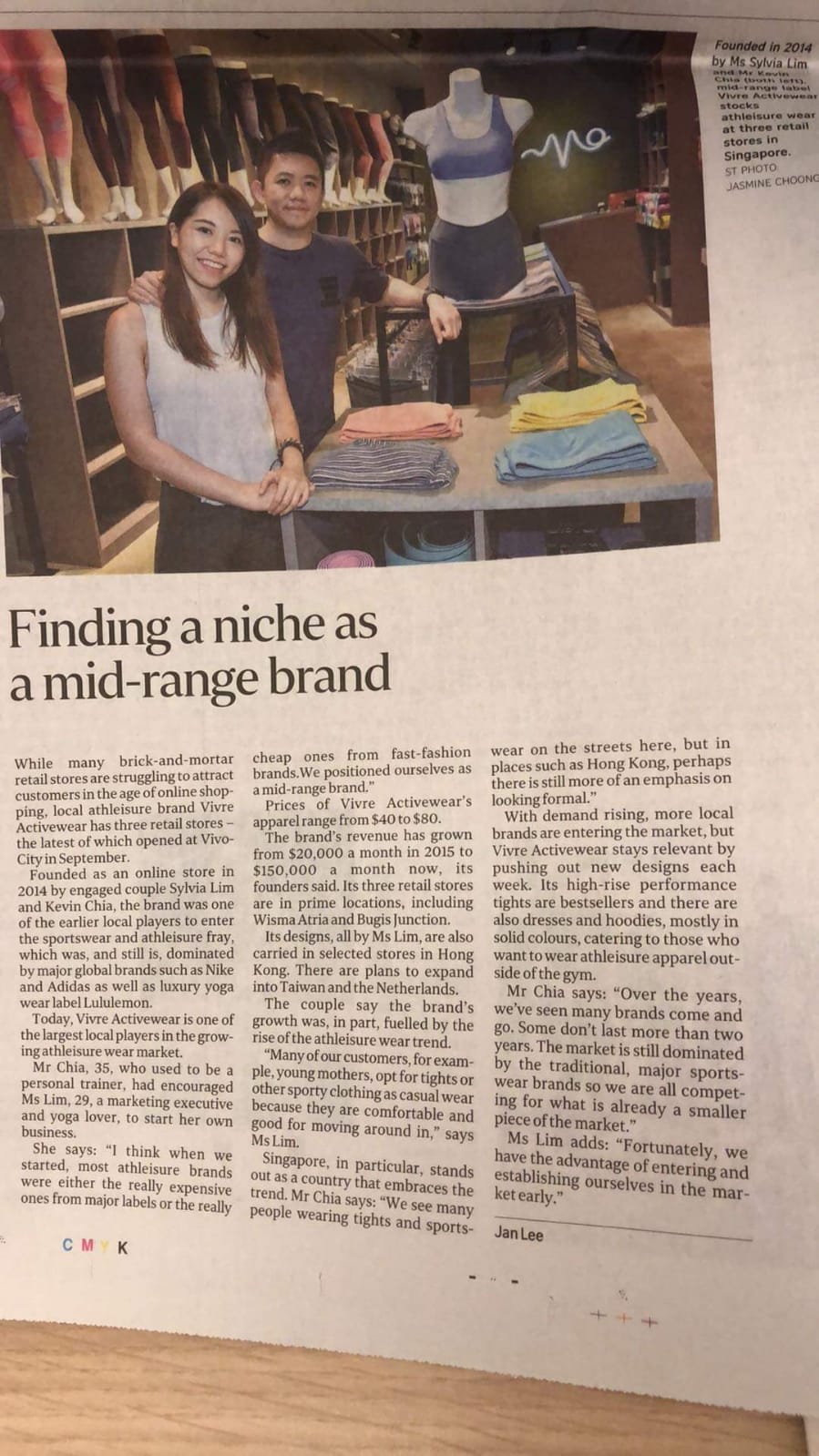
In 2019, around the time we opened Vivo City, the Straits Times ran a feature on Vivre. We did not pitch for it. A rival brand did, and somehow we ended up as the main feature instead. You can view the full clipping here.
That piece told the story of a brand finding its place between expensive international labels and cheap fast fashion. What I found interesting in hindsight is that this rival brand was pitching the exact same origin story in 2019 as we had been telling since 2013. Same narrative, six years later.
That told me something. The market was getting crowded with people who saw the same opportunity we had seen years earlier. The cake size was not growing proportionally to the number of people trying to eat it.
$2M+ in revenue. And the warning signs.
2020 and 2021 were our peak years. COVID was both a tailwind and a headwind. Athleisure demand went through the roof as people stopped wearing office clothes and started working out at home. Our inventory sold out easily. Net revenue hit $1.9 million, with gross crossing $2 million for two straight years. The years before and after, with physical stores running, we were consistently doing $1.6 to $1.8 million.
We had also started paying ourselves properly in 2019, just before COVID hit, which meant we benefitted from government grants over the following years in a way that was completely legitimate and well-timed.
But even at the peak I was watching the market closely. Online-only brands that launched during the pandemic were buying market share with 50% discounts. Customer price expectations were shifting. They were not building sustainable businesses. They were buying customers.
When your competitor needs a 50% sale to get customers through the door, that is not a growth strategy. That is a slow bleed.
I also had a front-row seat to what happens when a competitor misreads the market. One brand opened a flagship of around 1,000 square feet at Takashimaya. Rental there would have been close to $40,000 a month. At that point our combined rental across two to three locations was only $30,000 total, and we had more retail space and more geographic reach. Their unit economics were broken from day one. They closed eight months into the lease. When we heard they were closing, we extended our pop-up at Wisma for another six months just to capture their customers before we wrapped up that location ourselves.
Engineered. Not forced.
Physical retail was getting harder. Pre-COVID our stores were doing five-figure monthly profits. Post-recovery, margins had compressed and each store carried around $30,000 in monthly overhead between rental and manpower. The model had run its course.
The decision was clear: wind down in a controlled way, timed with the natural end of each lease. No panic. No emergency closures. Just a planned exit, store by store, on our schedule.
One big part of the plan was inventory. At our peak we were sitting on more than $500,000 worth of stock. To make the online-only transition work cleanly, we needed to get that down to below $100,000. We ran 20 to 40 percent discount sales over roughly four months to clear it. Not desperate discounting. Deliberate. The customers who came in for the sale got to try the product, entered our database, and became exactly the kind of buyers we wanted when we went online-only. The clearance was customer acquisition in disguise.
The last store, Vivo City, closed in October 2024.
The clearance sale was not a retreat. It was the first move in the next phase.
Vivre Activewear is still running today, online only, with a more intentional product approach. Slower launches, better designs, no pressure to push weekly drops just to hit revenue numbers. By staying under $1 million in annual revenue we deregistered for GST, which improved net profitability. The profit from the online-only model today is better than most of our peak years with full retail operations running.
Vulcan Post covered the closure story in November 2024 and verified our P&L independently before publishing. You can read it here: Why this S'porean activewear brand closed its outlets despite hitting S$1.9M annual revenues.
Manufacture your luck. Then know when to cash out.
Looking back, a lot of things went right for us. The influencer traction early on. The COVID timing. The ST feature we never asked for. You could call that luck.
But luck is not random. You position yourself for it. We were in the market early, we understood our unit economics better than our competitors, we watched what was happening around us, and we made decisions based on what we saw rather than what we hoped for.
In 2019 I already knew the cake was not going to get bigger fast enough for everyone trying to eat it. More entrants, same-size market, brutal price wars. The question was not whether things would get harder. The question was whether we would leave on our terms or theirs.
We left on ours. Semi-retired in 2024. And the business is more profitable now than it ever was when we had five people on payroll and three stores to manage.
That is the game. Know the rules better than everyone else. Position yourself for the upside. And know when to fold a hand that has already peaked.
Want to talk through your own business decisions? That is exactly what the consultancy is for.
See how I work